
What makes it different.
FocalNest takes the job of holding a household's plan together: scheduling around what's already happening, tracking what a week can realistically hold, and handing whoever opens it the one thing worth doing next. Every part of it tunes to the person using it.
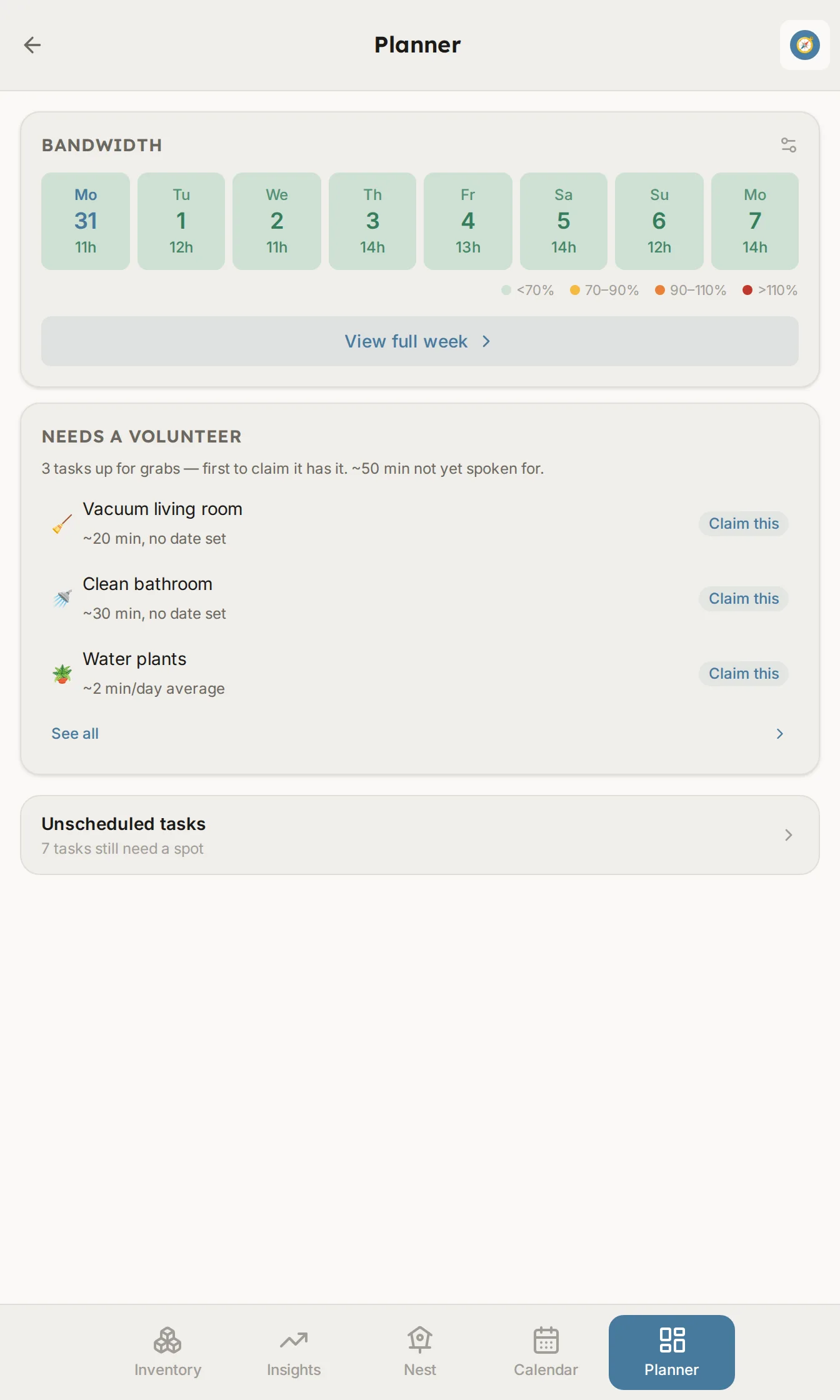
The plan keeps itself.
Most planners hand you an empty grid and leave the filling to you. FocalNest fills it. A new task gets placed automatically — around school hours, around work, around everything already on the calendar. Through the day it looks for gaps and slots things in. Overnight it re-plans the week.
The important part is what it refuses to touch. Two things make a task protected: pinning it to a fixed time, or marking its consequences as serious. Protected tasks never move on their own. If something has to give, FocalNest raises a suggestion and leaves the decision with you. Everything else it rearranges freely, and tells you what changed.
This is the reason to connect a calendar. Google Calendar links directly, and anything that publishes an iCal address subscribes the same way. Those events are the shape the scheduler works around, so a dentist appointment that appeared this morning is already accounted for by the time the day is planned.
It goes the other way too, if you want it to. Turn on writing and FocalNest adds a calendar of its own to your Google account, holding what you've actually committed to. Suggestions stay out of it until you confirm them. Calendars you connected stay untouched: FocalNest only ever writes to the one it made, and only ever reads the rest.
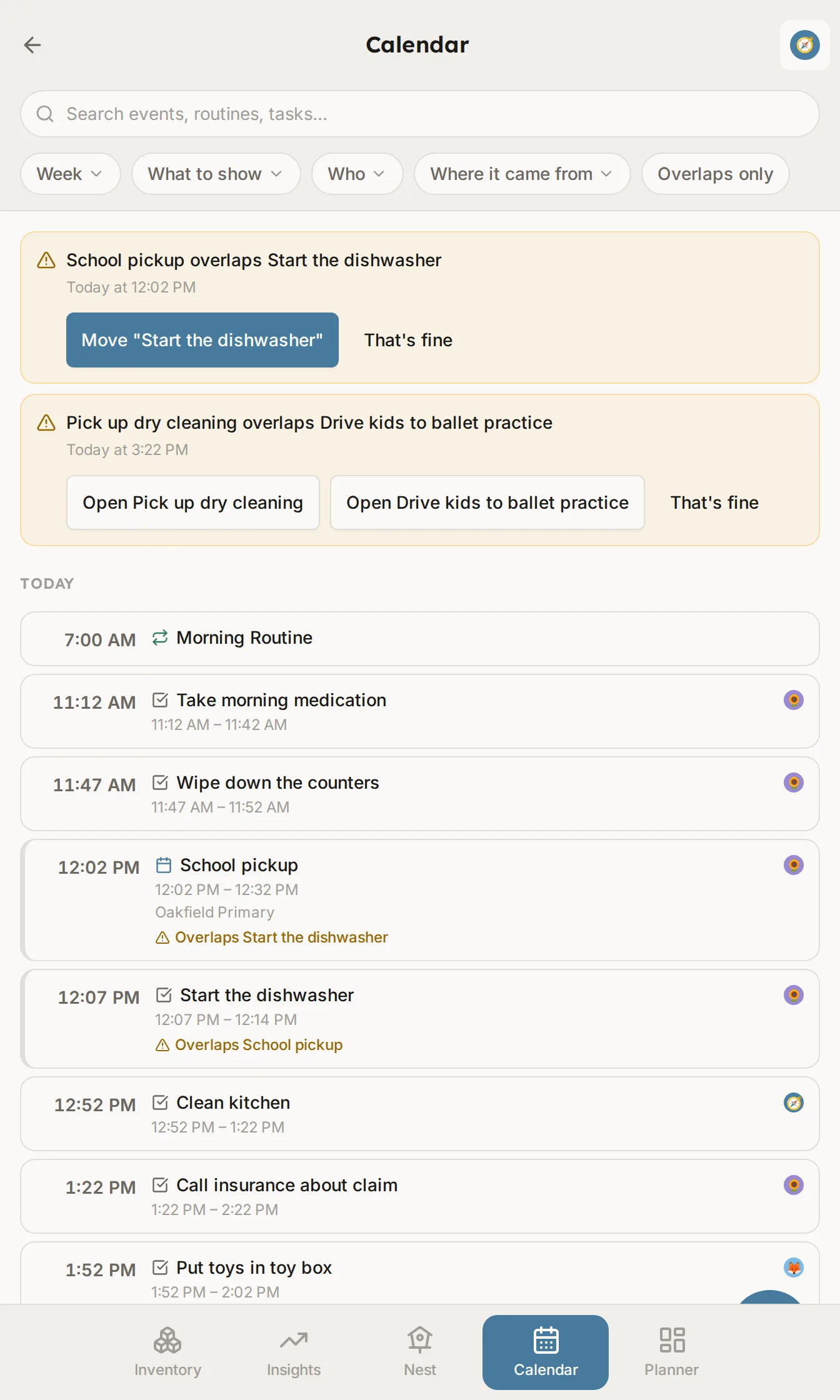
The week, in one list.
A month grid is a good way to see the shape of a month and a poor way to answer what's next. So the calendar is a list, in order, under day headings — events, routines and anything with a time, together.
Which matters because those three things usually live in three places. Soccer is on the shared calendar, bedtime is a routine nobody wrote down, and the form is due Wednesday. Seeing them apart is how a household finds out at 5pm that two of them are the same hour.
FocalNest reads them as one timeline and says so when two collide. If one side can move, it offers to move it. If neither can, it says that plainly and leaves the choice with you — two plans overlapping is an ordinary week, not a mistake to be corrected.
Narrow it by what kind of thing it is, who it's for, or where it came from. Each row shows what it belongs to, so a task is read against its routine rather than loose in the week.
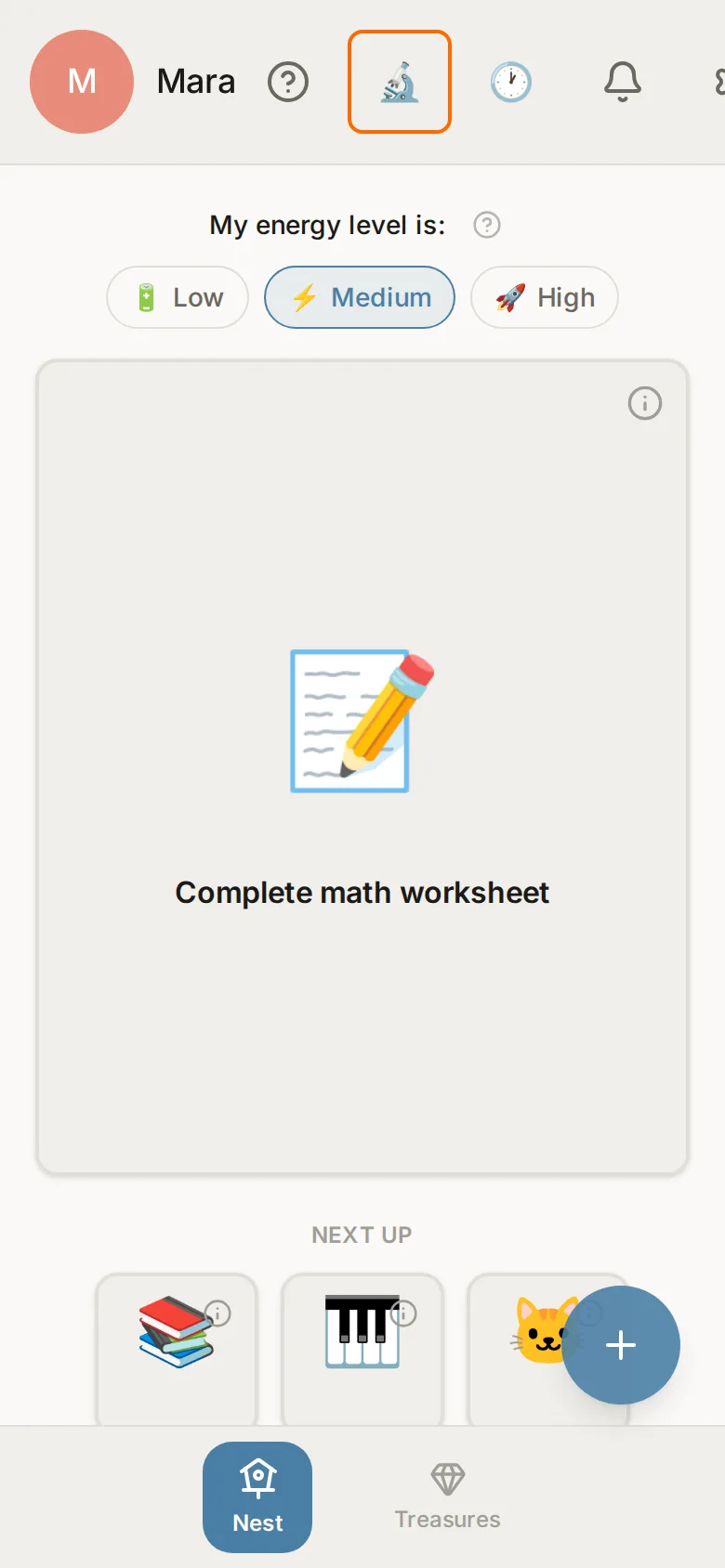
Fewer decisions, same control.
A list of ten things is a decision you have to make before you can start, and that decision is its own ADHD tax. FocalNest weighs each task against its deadline, how much it truly matters, your energy right now, and where you are — then points you at the single one worth starting with.
It's a strong suggestion rather than a lock. Reorder, skip to something else, or follow the routine you already know. The app holds an opinion so you don't have to generate one from a blank slate, then gets out of the way.
When that one is done, the next appears.
Reminders that escalate instead of nagging.
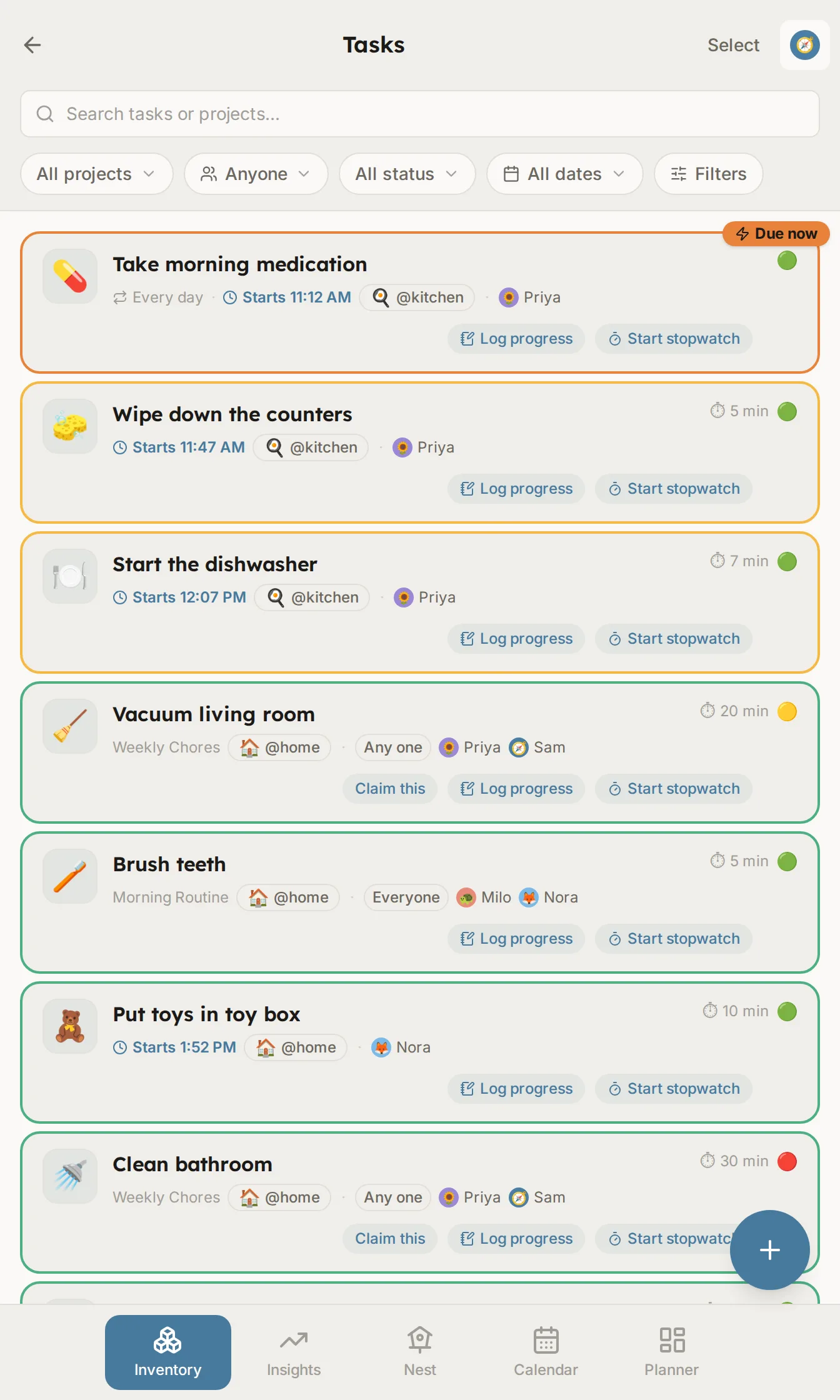
Most apps fire the same notification on a loop until you silence them. FocalNest tracks every task against its deadline in real time and shifts its color instead: calm green while there's room, amber as it gets close, orange when it's now, red once it's overdue.
The task model underneath bends the same way. "Roughly every few days" is a real recurrence here, as is medication three times a day six hours apart. A deadline can stay soft and nudge gently long before it starts to press.
There are no thresholds to configure. Color does the talking, so a parent can read the room from across it. Every state pairs its color with an icon and a label, so it stays clear for colorblind users.
Matched to your real capacity.
Some days are high-focus. Others are survival mode. Tag a task with the energy it needs, set today's energy once, and the app surfaces what's achievable while quietly holding back what isn't.
The weekly planner goes further, catching a day that's simply too full, high-energy work stacked onto a low-energy morning, or four heavy days in a row. It shows the whole family's load side by side, so help can go to whoever is actually buried rather than whoever complains loudest. Like the rest of the scaffolding here, it's optional.
The screen in the kitchen.
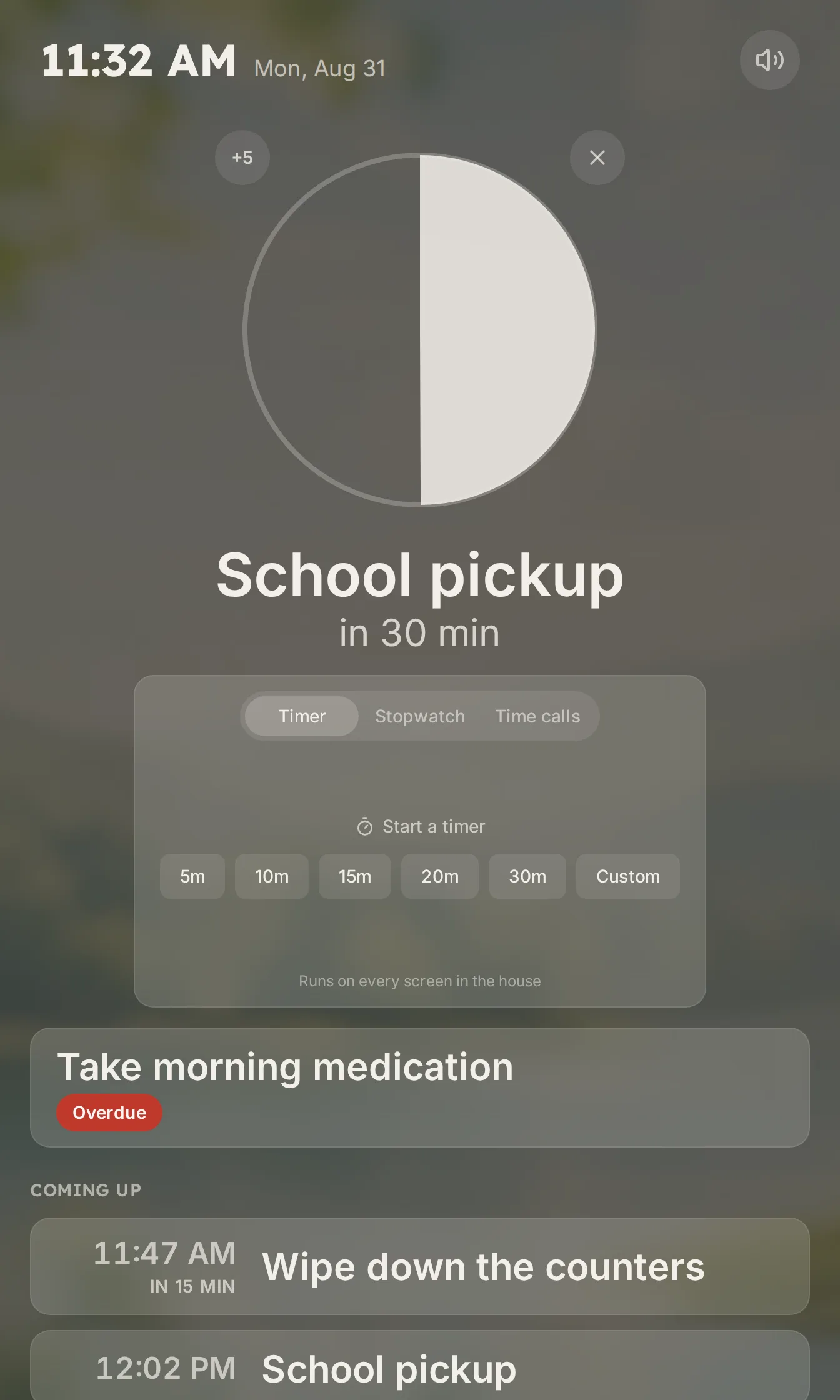
A tablet propped on a shelf becomes the family's shared display: what's coming up, and how long until someone has to leave, visible without anybody opening anything.
Every row is a time and a title. No names, no avatars, nothing about who owes what. A screen in the hallway can show the household its next few moments without putting anyone's day in front of whoever walks past.
It stays calm deliberately. Nothing demands attention until something is genuinely close, and quiet hours keep it silent through the evening. When one thing is truly urgent it sits above the agenda on its own, rather than in a list nobody reads.
A timer, a stopwatch, and spoken time checks share the same screen. The time checks say the hour out loud — "it's seven fifteen, fifteen minutes left, then we're leaving" — closer together as the deadline approaches, because a voice that keeps an even beat becomes wallpaper right when it needs to land. It's the thing a parent already does out loud during a departure crunch, said by the screen instead.
More than one screen stays in step. A timer started in the kitchen is running in the hallway too. Each screen keeps its own sound settings, so the one outside a bedroom can show the countdown and stay silent.
It's the same FocalNest everyone's already using, on tablets you already own. There's more on picking screens and placing them, including what to look for in a second-hand tablet.
The bus leaves at 8:15am sharp. Please return the signed slip and $6 by Wednesday. Parent volunteers still needed…
Forward the email. Walk away.
Half of a household's admin arrives by email, while you're doing something else. Reading it isn't the hard part. The hard part is that reading it and acting on it happen hours apart, and the gap is where the permission slip gets lost.
Every adult can turn on their own forwarding address. Send anything to it and FocalNest creates both halves of what was in there: the appointment goes on the calendar, and the thing you have to do beforehand becomes a task carrying the real deadline, filed into the right project and tagged with where it happens. Write a line above the forward and your instruction wins.
When both parents forward the same newsletter, FocalNest recognizes it and merges it into one set of tasks. If the email names who something is for and exactly one person fits, that's who gets it. Anything less certain stays with whoever forwarded it — a task on the wrong person's list is worse than one on yours.
Everything it creates is marked with the email behind it, so you can open the original or undo the whole import if it read the thing wrong. Work anyone already did survives the undo.
Progress counts, not just the finish line.
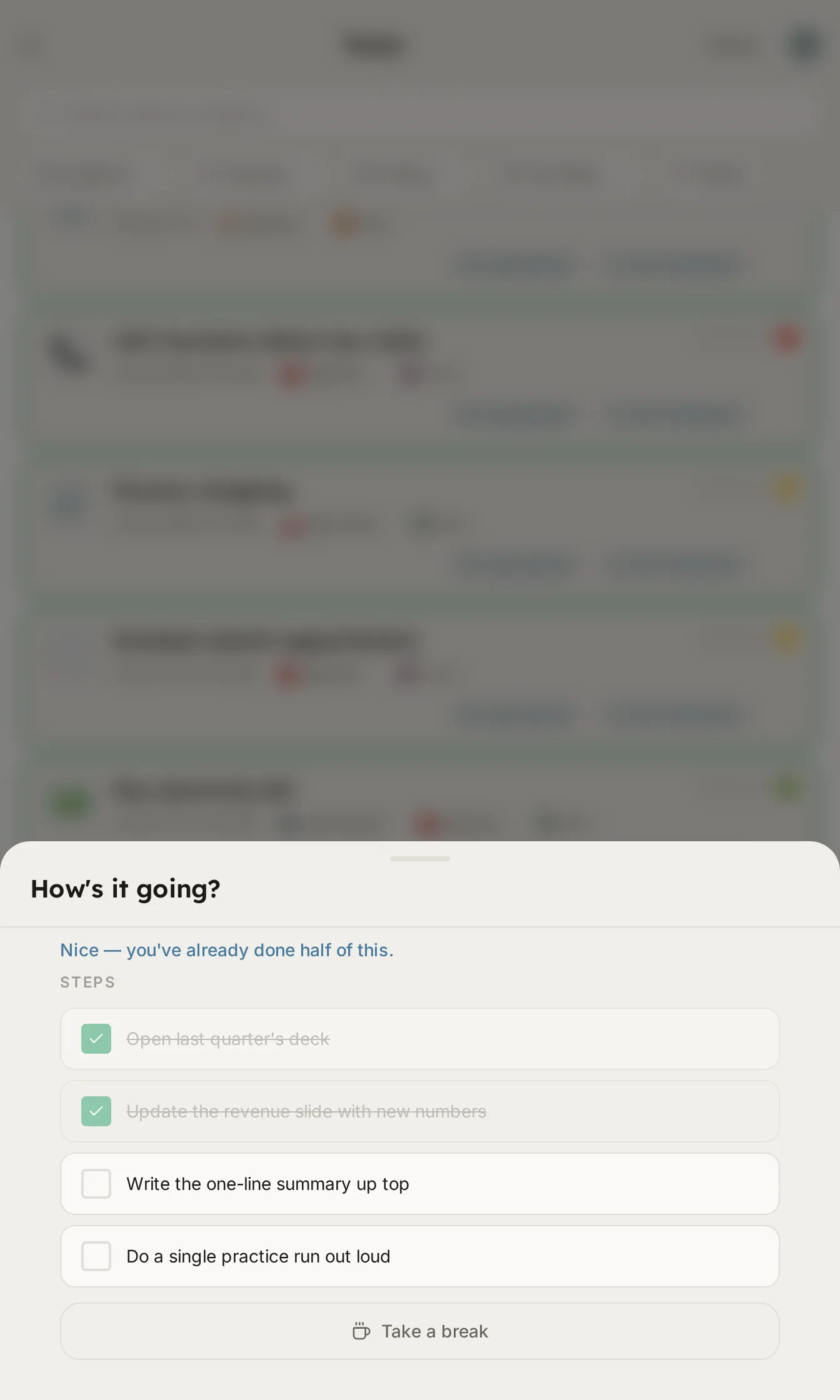
Most apps are binary: done or not done. That's a poor fit for a brain that works in bursts. FocalNest lets you report in without finishing — just getting started, making progress, almost there. Effort is visible and it counts.
Stuck partway is a place to pause rather than a failure. Once there's some progress, a Take a break option appears — thirty minutes, an hour, until tomorrow — so stepping away is a normal move.
The progress bar never shows zero. You only ever see momentum, never a bar reading back "you have done nothing."

Motivation that survives a bad day.
Every real completion gets its celebration, always. On top of that, kids sometimes unlock a card from a curated collection — dinosaurs, bugs, rocks and minerals, each carrying a real fact worth knowing. Sometimes, not every time. The unpredictability is the mechanism.
We deliberately didn't build this around streaks. A broken streak turns one hard day into a loss, and that's exactly the pressure that makes ADHD task management feel worse. No streak counter exists anywhere in the app, on purpose.
Parents choose which collections a child draws from, and can add real-world rewards alongside them — extra screen time, a movie pick — with daily limits they set.
Describe the chaos. Get a plan that fits an ADHD brain.
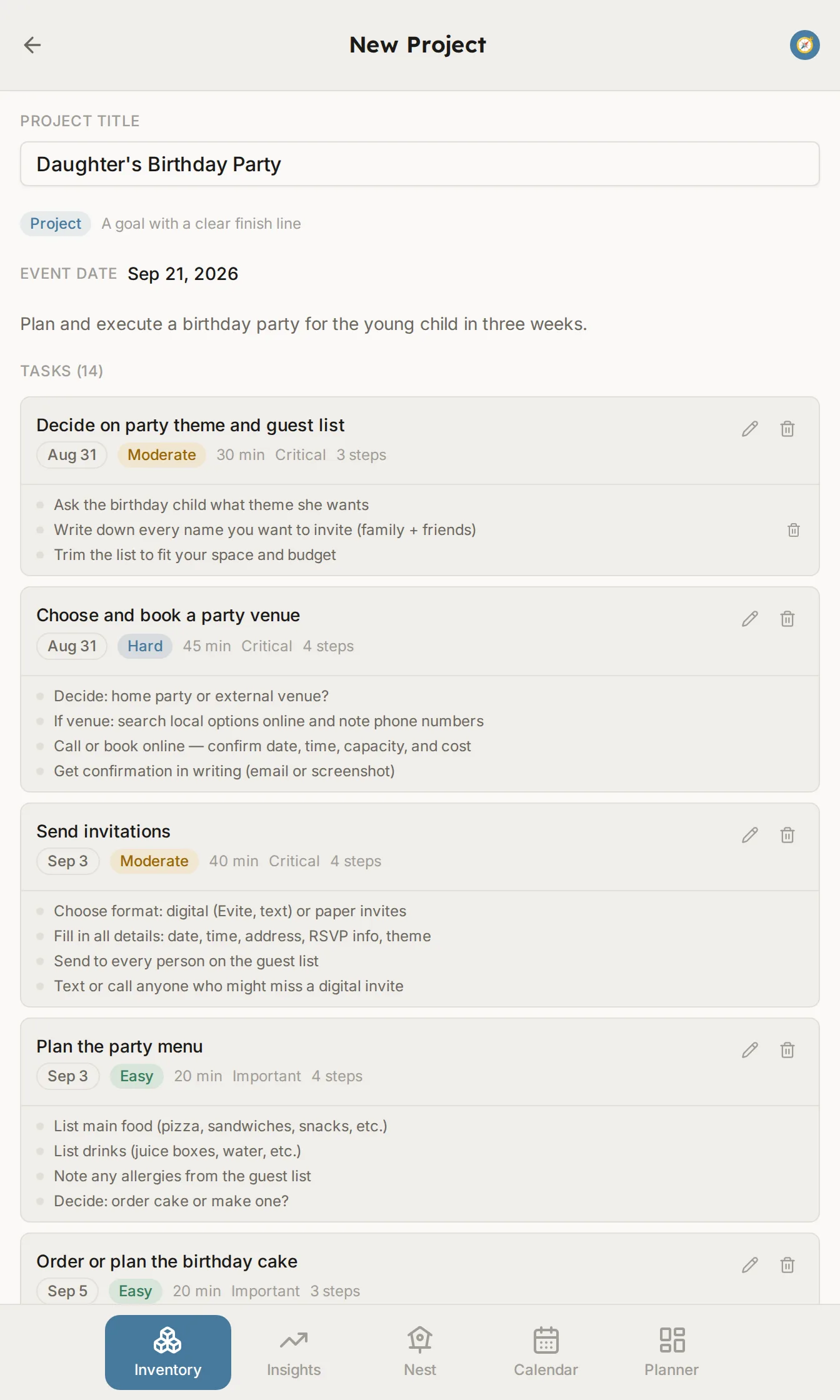
"Throw my daughter a birthday party in three weeks." "Build a morning routine that actually gets us out the door." Tell FocalNest in plain language — or start from a ready-made routine and adjust it — and it drafts the whole project for you to review and edit.
It plans the way a good ADHD coach would. Estimates skew generous, because ADHD brains reliably underestimate how long things take. It keeps demanding tasks out of the 3 to 8pm window, when school-age medication is wearing off and friction runs highest. It anchors routines to real moments rather than arbitrary clock times, and plans backwards from a deadline.
You get a structured draft in seconds. Nothing is saved until you say so.
The hardest part is starting.
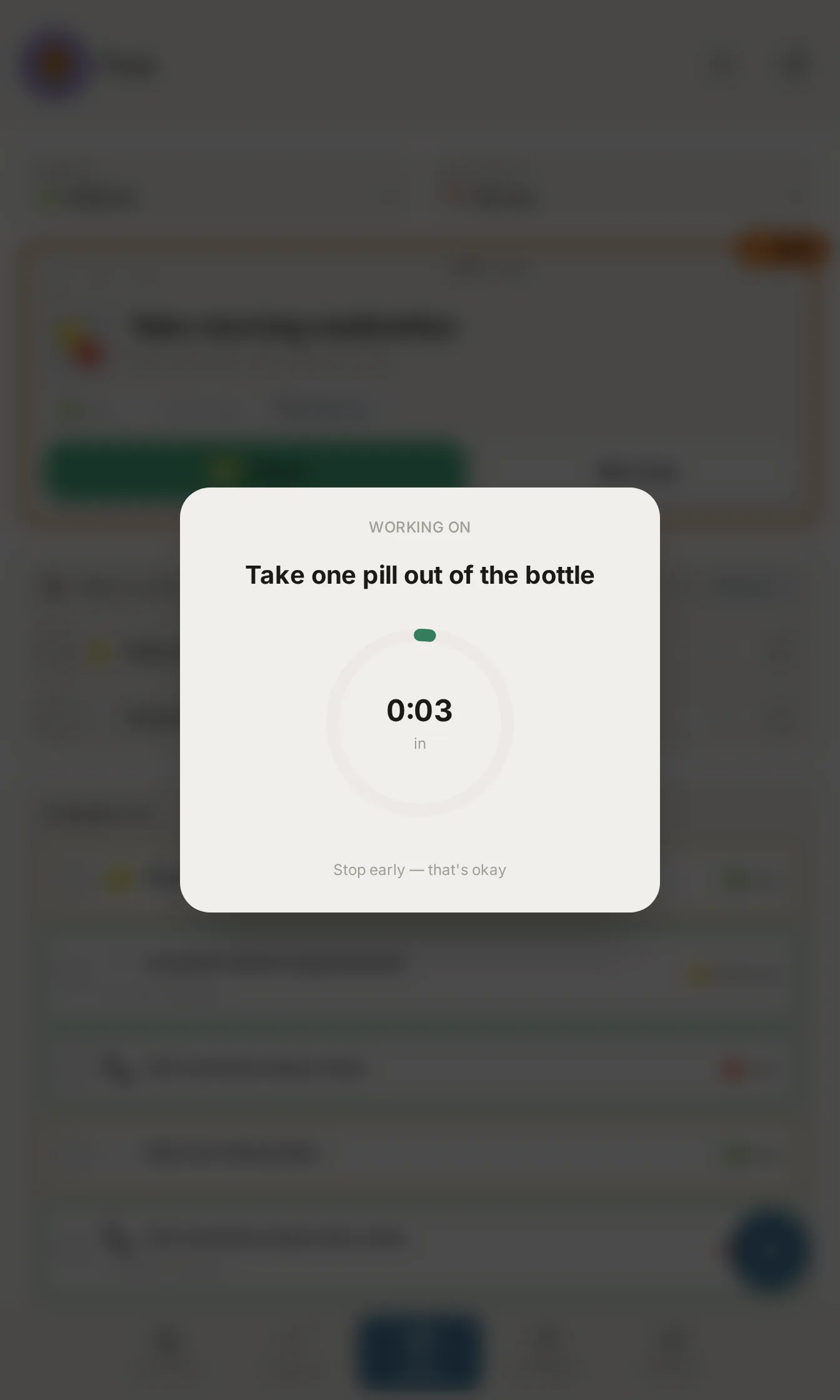
ADHD task initiation isn't laziness. It's a neurological activation problem, and knowing that changes the design. Instead of "Finish the science project," FocalNest breaks off the smallest physical first move: "Open the notebook to a blank page." Something you can do in two minutes without deciding anything.
Tap Just 2 minutes and a short session begins with a calm lead-in — grab what you need, phone face down, water nearby — then two real minutes of doing.
The wording adapts to whoever is reading it — a fluent adult, an early reader, and a four-year-old who can't read yet each get a first step written for them.
The whole family, pulling together.
FocalNest puts the whole family's tasks in one calm place — not so anyone can be watched, but so you can move together. See who's flying and who's stuck, and step in with help rather than a reminder.
Hard things are easier with company. Body-doubling lets someone start a dreaded task alongside another person, turning "I can't make myself begin" into "we're doing this together."
Everyone gets their own avatar and color. Private tasks stay private, shared tasks are visible to whoever needs them.
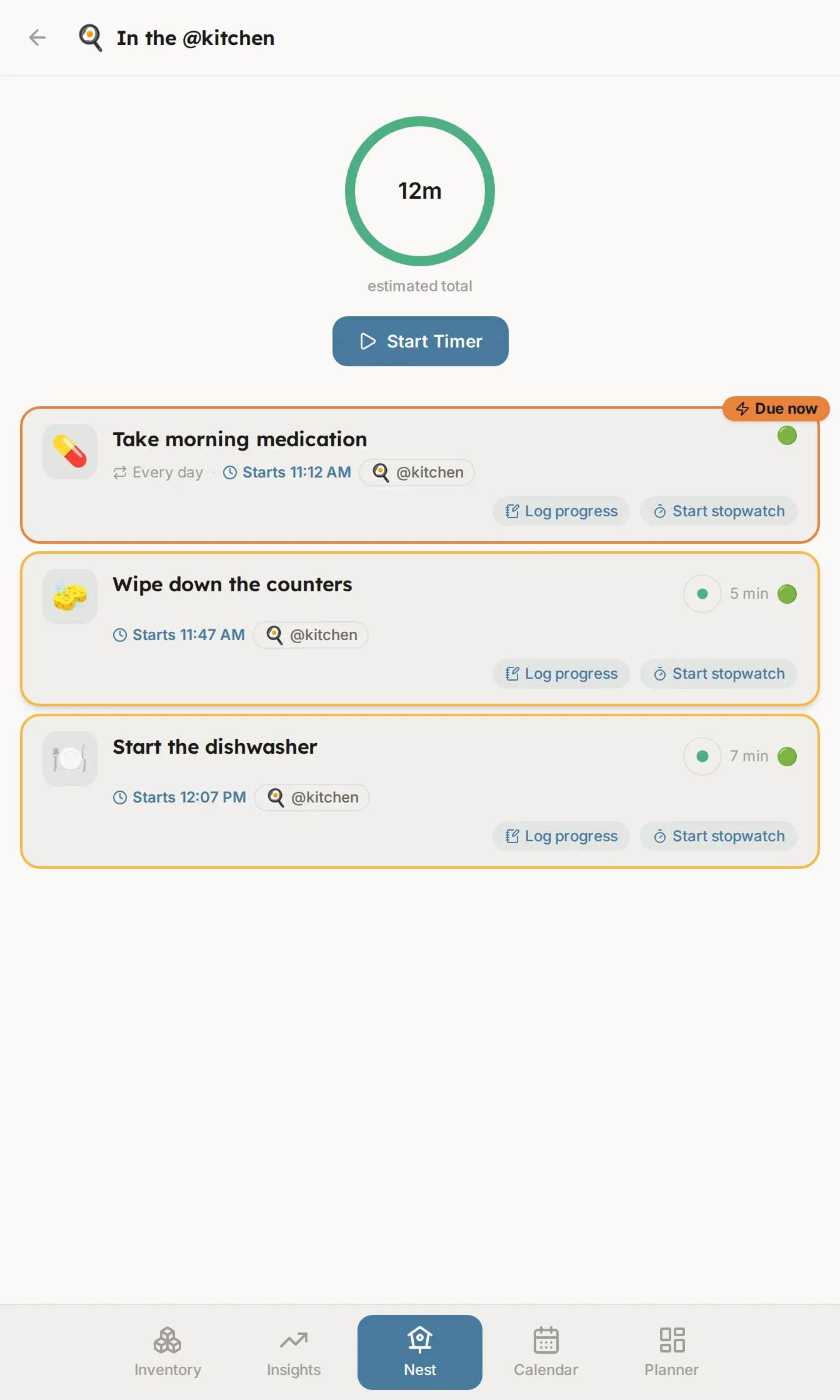
While you're in the kitchen anyway.
ADHD support works best at the point of performance — the exact moment and place a thing needs doing. So when your current task is tied to a place, FocalNest quietly surfaces the other small things nearby. You're in the kitchen for your morning medication anyway, so it mentions the counters and the dishwasher: about twelve minutes for both.
This is tag-based, not location tracking — FocalNest never asks for your location. You tell it a task belongs to the kitchen, and it remembers.
Batching what's physically near you beats context-switching across the house — a nudge that meets you where you are, rather than a list you have to consult.
You choose what each person gets.
None of this is forced on anyone. FocalNest's support comes in four categories you switch on per person. Turn on what helps someone and leave the rest off, so a family member who just wants a clean shared list gets exactly that.
Time awareness
Duration rings, generous buffers, deadline alarms, and ambient countdowns.
Getting started
Two-minute first steps, energy matching, gentle escalation, and body-doubling.
Focus & attention
A calm focus mode, a soft way back in after an interruption, and quiet insights.
Transitions
Heads-up warnings before a change, and tasks grouped by where you already are.
The interface adapts by age as well. Adults get the full management surface — projects, the planner, the family view — along with durations and descriptions. Kids get a simpler, execution-first screen: bigger visuals, one thing at a time, no clock pressure. And the steps the app writes for a child are pitched at their reading level, down to three words for a pre-reader.
Several of these categories reach past ADHD. The transition warnings, the consistent routine structure, and the motion controls are the parts autistic family members tend to reach for first.
Everything else it does.
The rest of what comes in the box, each shaped by the same neurodivergent-first thinking.
Shared family calendar
Connects to Google Calendar, or any calendar with an iCal address. Synced events are what the scheduler plans around, and it can write back into a calendar of its own.
Visual timers
Time shown as shrinking space rather than numbers, for brains that do not feel it passing.
Ambient countdowns
A quiet "school pickup in 40 minutes" strip, so a transition never lands as a surprise.
Weekly planner
Plan the week against the bandwidth a week actually has, instead of an infinite list.
Body doubling
A calm "someone is here with you" presence for the tasks that are hard to start alone.
Flexible recurrence
"Roughly every few days" with a soft deadline, because rigid daily schedules collapse.
Several times a day
Medication three times, six hours apart. Water eight times. The patterns real life needs.
Steps written for the reader
A first step is pitched at the reader's level, down to three words for a child who cannot read yet.
Away periods
Mark a stretch away and routines stop expecting you. They start again when you get back, with nothing owed.
Pause a task
Set something down without deleting it. It stops appearing for everyone, and remembers who it belonged to.
Gentle insights
Patterns and encouragement in plain language. No raw scores, no pressure.
Private by design
COPPA-compliant from day one. When the AI drafts a plan it sees your household shape — roles and age ranges, not names.
Ready to try it?
We're in closed beta. Request access and we'll send you a personal invite.